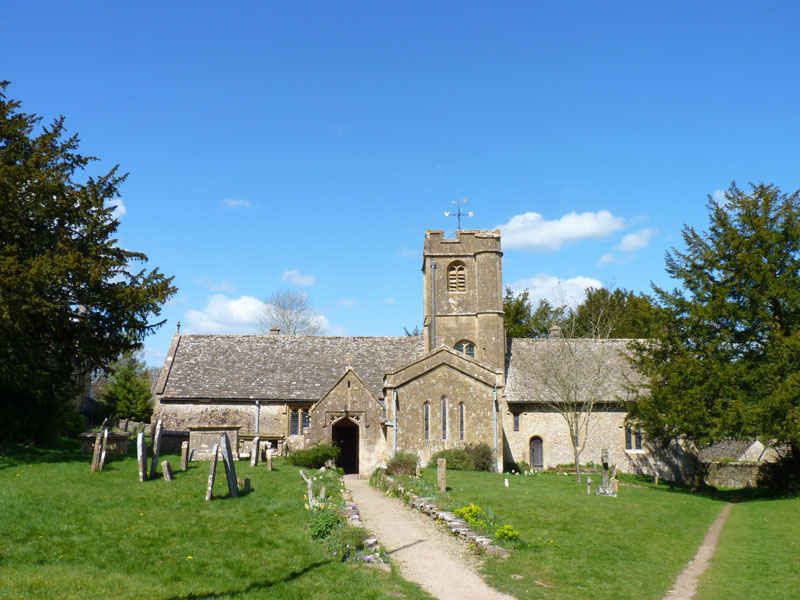
Tucked away on the edge of a small Cotswold village is a quite extraordinary church, though it you would not guess this from the outside. St Nicholas at Oddington. I cycled out on Marjorie recently to see for myself. The church is located outside the village, as it is no longer the central place of worship, the original village being abandoned in the early 18th century and located further up the hill, possibly due to the usual cause of the Black Death.

Looking like a typically picturesque Cotswold church, it has an interesting graveyard and some unusual Restoration era tombstones, which are shown on my other blog here.
 The South door inner archway is Norman and has an interesting serpents head detail at each end - maybe a reminder of why you are attending worship?


The stone benches inside have deep grooves which are said to be where arrowheads were sharpened. (Churches this old were also commonly the main defensive building and weapons stored in the porch roof).
So far, so quaint and historical. But when you enter the church proper, your breath is taken away by this -
What is thought to be our country's largest surviving Doom wall painting, dating to about 1340. I was literally rooted to the spot: imagine the effect it must have had on the original devout and largely illiterate Medieval congregation. Like all Dooms, this one shows in graphic and often lurid detail, the consequences of sin and the rewards of righteousness. The Godly are summoned to Heaven on Judgement Day by welcoming angels;

 Christ sits over all in Glory.

For the Damned, sinister demons execute all manner of grisly tortures, to be endured for all eternity. Once you get used to looking at the (now) sombre tertiary tones it's quite easy to work out what torments are going on.
This part of the Doom is of a later date (1520) and there has been some speculation as to what this figure represents. The church pamphlet suggests that it is a reference to a contemporary play by the writer John Skelton, 'Magnificence' and it's various characters.
Seen with Jacobean pulpit nearby -
Looking down towards the 'newer' Early English Chancel - Elsewhere there are traces of more decorations on the Early English archways here - the vivid turquoise blue coming from copper salt pigment.


But the Doom is not the oldest paintings to be found here - they are inside what was the original Saxon nave (where I am standing to take this photo) and chancel, and is now the South Chapel. It's easy to see how small and intimate it once was. (Note the old gurney, just to the right, a cheery little reminder of one's own mortality).
Inside the chancel which is also the bell tower and if you look beyond you can see on the far wall, to the right, some pale patterning. The first altar stone is still there as well.
A closer look shows trellis work and faces - as with all my photos, they are quite large, so do click on for detail.
There are always many layers to a church, and sometimes more recent relics can be just as touching as the antiquities - I love this little bell ringer's prayer, maybe about 30-40 years old, and probably barely moved since the day it was placed there.
And another *recent* treasure, this screen separating the old South Chapel from the main nave, looks quite plain and unremarkable, until you learn that it was made by Peter Van der Waals, an Arts and Crafts craftsman who worked in the Cotswolds at the beginning of the 20th century. As the church was being restored at this time, 1912, it must have been part of the restoration process, but I am speculating here.
After a very long time of pottering and wonderment, Marjorie and I cycled back towards Oddington. What had been a clear blue summer sky was now clouding over and we had eight miles to cover. Needless to say we didn't make it. Two miles from home, the rain caught up with us. I arrived home drenched, but happy.


We are quite spoilt for delightful little churches in the UK - almost every village and small town has an old and interesting place of worship, many of which have been around for the best part of a thousand years or more. But sometimes we find unexpected gems, often in the smallest and most tucked away of places. Such is St Andrew's in the Cotswold village of Sevenhampton. Although it has Norman origins, the tower is of a later build, 'Early English' - or, more simply, the Medieval period. It also has a octagonal stairway running up it, which is visible from outside. You would have to be tiny - or from another century - to get up it without some discomfort.

The tower was a later addition, courtesy of a wool merchant John Camber who stipulated in his will that whatever parish he died in, there he would be buried and the church benefit. So the tower was built in his honour in 1497, but necessitated inner supports; to see flying buttresses on a church this small would be unusual - to see them inside is, in my limited opinion, nothing short of astonishing. Looking down the nave, you can just see the diagonals propping up the tower.


The South side buttress -

The North side buttress

View of both buttresses from the North side. Disused Charles 11 font (17th Century) visible -

The tower itself is small but impressive, with simple fan vaulting. This is also the bell tower, housing three bells, the earliest dating from sometime in the 15th century, the most recent on from the 18th. A mere stripling.

For me, even more fascinating than the buttresses, was the concealed mensa stone, the old original altar - many of these mensa's were removed (and hidden) during the 16th century Reformation. Some have since been replaced, but this one became part of a 'squint' - it is very low, as the floor was raised at some later date. The mensa at St Andrews forms the top of the squint -

By holding my camera inside, I was able to take a couple of (blurry) shots of two of the five consecration crosses inscribed on what would have been the altar top.


What I love about our churches is their unpretentiousness. Despite their antiquity and historic pedigree, they are still places of worship and although loved, cared for and continually restored, they are often appear somewhat 'lived in'; things are stashed away, biros and sweets left in a favourite pew, always a box of old toys tucked away to keep little ones quiet during service. Sometimes they form quite beautiful, if unintentional, still lives.

Sometimes it is as if the spirits of past worshippers look down from the very walls...

...and the gradual process of centuries of aging renders a humble, rustic Medieval stoup into something quite divine.

Now we leave St Andrews and continue our walk, looking back for a final glimpse.


Has it really been two months? Apologies to everyone and thank you for waiting! But spring is here and today Marjorie and I took ourselves off for a shopping trip. First we stopped to get some eggs from a nearby honesty box. Then we began our trek to the butchers, out of the village and across the way, through winding lanes - can you see the tail of this one snaking away to the background?
This stretch is a long old grind uphill, never mind that there are pretty cottages to admire (which I could not afford the mortgage of if I sold every single on of my internal organs and then some).
There is about a mile of slog until we reach the war memorial and I dismount. A bit of gentle pushing is called for.
After a long, cold, winter, the Cotswolds are finally waking up.
Which way shall we go?
Down here? Lovely little tempting track which sadly leads nowhere in particular. 
We must turn right and, oh dear, another long slope up. We walk to the summit - after all, it is a gorgeous day to be out and about.
Finally we cross a busy road and begin a mile long leisurely spin downhill all the way - 
- to the pretty village where we will do our shopping. Slatters Butchers, the best kept secret in West Oxfordshire; free range and local meat at affordable prices. For this I have cycled seven miles. Inside in the cool, I fan myself rapidly as I order a small free range chicken, home made pork sausages and some neck of lamb (thrifty), while chatting to the lovely butcher about running marathons (him) and half dying from exhaustion (me).

There is a little deli-cum-village-shop attached to it. It's a bit pricey and I have problems deciding if I do *need* anything, but it's vital to support local shops, so Marjorie's panniers end up filled with a bag of meat, the two cartons of eggs, two bottles of Hook Norton beer, Strawberry & Elderflower cordial, lemon crunch biscuits made in the village and a wodge of mature cheddar. Plus my big flask of water. My debit card is lighter though...

Laden down like a desert donkey, Marjorie and I wobble our way home.
What came down has to go up again - though mostly walking, up to the top road where the trees line the horizon.
Mercifully it's a lot easier coming back, a lot of free-wheeling downhill - 
- back past the cottages.

Taking a different route back home, along a *real* road - with a warning sign. Sadly it didn't slow the cars whizzing by, though Marjorie eased up a little. Just in case.

Winding through the tiny neighbouring village.
And the last stretch home. Another hill. Did we walk or did we tackle it manfully? What do you think?